Production and Performance
From Broadway to Interactive Storytelling: What Live Theatre Teaches Digital Entertainment
How the 2010 revival of August Wilson’s Fences illuminates character, space, pacing, audience agency, and the craft of digital storytelling.
The backyard in August Wilson’s Fences is an ordinary place made extraordinary by what happens inside it. A family negotiates affection, obligation, ambition, and betrayal. Characters move around familiar objects, revisit old arguments, and sometimes say more through silence than through speech. The action is carefully written, yet no two performances can be completely identical: timing, attention, and the presence of an audience all affect how a scene is experienced.
That combination—an authored story brought to life through human attention—offers an intriguing way to think about interactive digital entertainment. A stage play does not require players or branching choices to be compelling, and a digital experience need not imitate a theater. But the two forms share difficult creative questions. How does a place acquire meaning? What makes an audience care about a character? When should an experience offer freedom, and when should it ask people to focus on a single dramatic moment?
Looking at the 2010 Broadway revival of Fences provides a useful starting point. It also helps us understand where theatrical storytelling and interactive media converge—and, just as importantly, where they remain different.
A stage is a world built from selective details
The setting of Fences is Pittsburgh in 1957. Its domestic world is specific, but the play does not need a sprawling collection of locations to show the pressures on Troy Maxson and his family. Wilson gives familiar space dramatic weight. The yard is somewhere people work, talk, confront one another, and imagine futures they may never reach.
In the 2010 revival, the production was directed by Kenny Leon. The Internet Broadway Database’s production record credits Santo Loquasto with scenic design, Constanza Romero with costume design, Brian MacDevitt with lighting design, and Branford Marsalis with original music. Those are different disciplines, yet they work toward a coherent stage world. A set is not merely a location; lighting, sound, clothing, and the performers’ use of space help determine how viewers read it.
Digital designers face a related task. A game environment or interactive narrative may let someone investigate a room, select objects, or return to a location multiple times. Every extra detail can reward attention, but detail without purpose can also obscure the story. An effective environment gives the audience clues about what matters: a recurring object, an interrupted routine, a passage that changes meaning as new information emerges.
The lesson is not that a digital setting should resemble a theatrical set. It is that design choices should serve dramatic understanding. A world can feel substantial because its details have relationships, not simply because it contains more things.
Why a character’s choices matter more than spectacle
A story becomes emotionally engaging when the audience understands what characters want, what they fear, and what those desires cost other people. In Fences, Troy’s hopes and frustrations affect Rose, their son Cory, and the wider family. The conflict cannot be reduced to a straightforward contest between a hero and a villain. Viewers may recognize Troy’s disappointments while questioning the damage caused by his decisions.
The 2010 Broadway production starred Denzel Washington as Troy and Viola Davis as Rose, with Chris Chalk as Cory and Stephen McKinley Henderson as Jim Bono. Much of its dramatic impact came from the relationships within that ensemble, not from changes of scenery or elaborate effects. Readers exploring the revival can find more context in our 2010 cast guide and production overview.
Interactive narratives approach character choice from another angle. A player may make decisions, explore alternatives, or shape a sequence of events. Those options become meaningful only if the experience establishes consequences and a believable human context. A choice between two brightly labeled buttons is not necessarily a dramatic choice; it can be a technical prompt without emotional stakes.
The interesting question is what happens after someone acts. Does a relationship change? Does the audience learn something new? Does an earlier decision become harder to defend? Theater can remind digital creators that consequence is not the same thing as spectacle. A quiet exchange may reveal more about a character than a visually ambitious scene.
Theater controls the sequence; interactive media negotiates it
A scripted performance has a deliberate order. The playwright and director shape the audience’s journey through entrances, pauses, revelations, and changes of emphasis. While individual performances vary, the major events in Fences do not change because one spectator wishes Troy had made another decision.
Interactive experiences may hand part of that control to the participant. Someone can decide where to look, which conversation to pursue, or whether to revisit an earlier location. Freedom can deepen involvement, but it also complicates pacing. A moment designed to build suspense may lose its force if the participant wanders away; an important clue may be missed; an emotional scene may arrive before the story has earned it.
This tension is a recognized area of study rather than an arbitrary analogy. In his open-access article “Interactivity and Player Agency in Videogame Adaptations of Hamlet”, Julian Novitz examines how adaptations of a theatrical work handle the relationship between inherited story and player control. His subject is Shakespeare, not August Wilson, but the underlying design problem is relevant: what happens to dramatic meaning when the audience can intervene?
The answer depends on the particular work. Some experiences preserve a central narrative and let participants investigate its edges. Others permit substantially different outcomes. Neither approach is automatically superior. What matters is whether the degree of freedom fits the story being told.
The audience has a role even when it cannot alter the ending
Theater is often described as less interactive than digital entertainment, but that comparison can be misleading. An audience listening together, reacting, or remaining unexpectedly silent affects the atmosphere of a live performance. Actors respond to the room while still working within the structure of the play. Participation does not always require changing the plot.
At the same time, some contemporary performance explicitly gives spectators tasks, routes, or choices. The boundaries between spectator and participant can become deliberately uncertain. Scholarship has explored such exchanges for years, and the edited volume Live Performance and Video Games: Inspirations, Appropriations and Mutual Transfers, published in 2025, addresses connections ranging from immersive theater to virtual-reality performance and game theater.
That range matters because the word interactive describes more than one behavior. A person may interact by navigating, choosing dialogue, solving a problem, observing from a different position, or influencing other participants. These experiences carry distinct artistic responsibilities. Designers must decide how to communicate possibilities, how to respond to unexpected behavior, and how to make the rules understandable without flattening the drama.
Even a conventional stage production offers a reminder: spectators bring memory and interpretation to the work. A digital experience can acknowledge that active attention without pretending every narrative requires a menu of choices.
Preservation changes how performances are remembered
A live production has a limited life in a particular cast, venue, and moment. The 2010 revival of Fences opened at Broadway’s Cort Theatre on April 26 and closed on July 11, according to the IBDB production record. Its performances were finite. Reviews, photographs, credits, interviews, and promotional videos help later audiences understand what happened, but they are not interchangeable with being present in the theater.
This distinction is especially important for an older production website. Pages that once advertised tickets can later serve as guides to a historical event. A cast list becomes a record of professional collaboration. Behind-the-scenes video offers a glimpse of working methods. An accurate chronology connects one revival with a play’s wider performance history.
Our production videos page collects surviving references to filmed material, while the history of Fences from 1987 to 2010 places the revival in context. Neither page should be mistaken for a complete audiovisual recording of the stage production. A digital archive is valuable partly because it makes the limits of its evidence clear.
Digital entertainment presents its own preservation problem. Interactive works depend on software, hardware, interfaces, and sometimes services that may change or disappear. A screenshot may show what a work looked like while revealing little about how it felt to navigate. A video may document a route through a game without preserving the ability to choose another. Like theatrical archives, digital collections need context as well as artifacts.
What each medium can learn from the other
For creators of interactive experiences, theatrical practice suggests a set of useful questions. Does a scene have a clear purpose? Can the audience understand a character’s motivation from what happens rather than from an explanation? Do spatial details reinforce relationships? Are silence, pacing, and restraint being used deliberately? When someone makes a choice, does it produce a change that the story recognizes?
For theater makers, interactive design raises different possibilities. Might a digital companion help an audience explore the history behind a production? Could a carefully designed archive make costume sketches, interviews, and scene histories easier to examine? Could educational experiences invite students to compare interpretations without rewriting a playwright’s work or implying that a simulation is an authorized performance?
These are possibilities for creative practice, not claims about features offered by the original Fences website. The 2010 production was a Broadway revival of a scripted play; it was not an interactive game. Its relevance to digital storytelling lies in the discipline of characterization, performance, setting, and dramatic consequence.
The strongest connection between the stage and digital entertainment is therefore not a particular technology or business model. It is respect for the audience’s experience. Whether someone sits in a theater or navigates a responsive story world, design succeeds when attention has a reason to deepen.
Returning to Fences
The backyard in Fences does not give spectators unlimited freedom. It gives them a place to witness decisions whose consequences unfold across a family. That is precisely why it makes such a useful comparison for interactive media: it reminds us that a memorable story does not begin with the number of options available. It begins with people, relationships, and details that matter.
Digital forms can expand the ways an audience encounters a narrative, but they cannot substitute interaction for a compelling dramatic foundation. The most useful exchange between theater and new media happens when each respects what the other does best.
For more about the production that anchors this discussion, return to the Fences on Broadway homepage.
Further reading and sources
- Internet Broadway Database: Fences, 2010 revival — verified run dates, cast, and creative credits.
- Playbill: Look Back at Fences With Denzel Washington and Viola Davis — retrospective coverage of the 2010 production.
- Julian Novitz, “Interactivity and Player Agency in Videogame Adaptations of Hamlet” — scholarly discussion of adaptation and agency.
- Live Performance and Video Games, Columbia University Press — research into connections between live performance and video games.
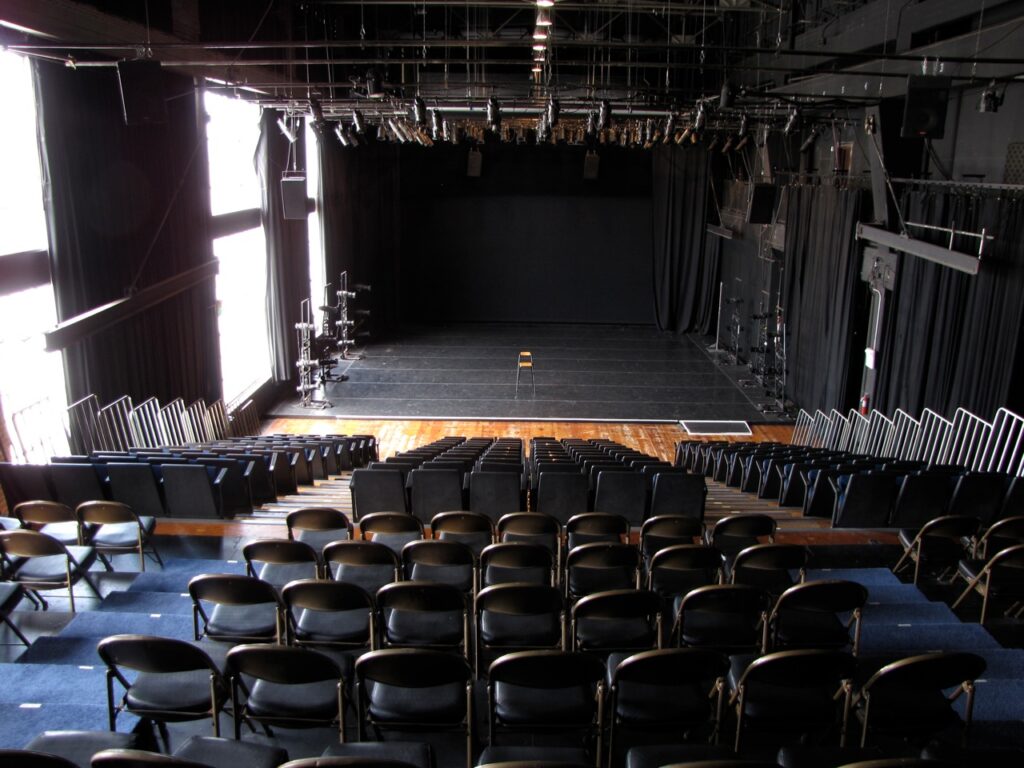
Featured image: Photograph: Andrew Burmester, CC BY-SA 3.0; WordPress may resize the display. The interior of Z Space theatre in San Francisco, used to illustrate audience viewpoint and staging.