Production and Performance
From Stage Design to Digital Game Worlds: How Theatre Shapes Visual Storytelling
What the 2010 Broadway revival of Fences reveals about stage space, light, visual hierarchy, and the design of interactive game worlds.
A man sits in his backyard on a Friday evening with a pint bottle and his best friend. He’s just been paid. He’s telling a story that gets bigger every time he tells it. His wife leans in the doorway and lets him talk, because she’s heard it all before and loves him anyway. That’s how August Wilson’s Fences begins, and it’s about as ordinary an opening as a play can have. By the end, almost nothing in that yard is ordinary anymore.
The man is Troy Maxson. He’s fifty-three and collects garbage for the city of Pittsburgh. It’s 1957. Troy was once a brilliant ballplayer in the Negro Leagues. By the time Major League Baseball let Black players in, he was too old to get his chance. That bitterness sits under everything he does. It shapes how he treats his wife Rose, how he fights with his son Cory, and how he talks to every visitor who comes through the gate.
The play is about one family. It’s also about the walls built around that family by race, by work and by missed chances. Some of those walls are out in the world. Some Troy builds himself.
The 2010 Broadway engagement
The revival played the Cort Theatre on West 48th Street. In a neat twist, that same house was renamed the James Earl Jones Theatre in 2022, after the actor who first played Troy on Broadway. Previews began on April 14, 2010. The production opened on April 26 and closed on July 11. IBDB’s production record lists 13 previews and 88 regular performances, and it describes the run as a limited engagement. Tickets were famously hard to find for most of it.
Denzel Washington played Troy. Viola Davis played Rose. Kenny Leon directed. It was the first time Fences had been back on Broadway since its original 1987 production, which starred James Earl Jones and won the Pulitzer Prize for Drama that same year. More than twenty years later, a new generation got to see it on a New York stage.
The 2010 revival did very well at that year’s Tony Awards. It won Best Revival of a Play. Washington won Best Actor in a Play, and Davis won Best Actress in a Play. Six years later the two stars carried the story to the screen. Washington directed and starred in the 2016 film adaptation, and Davis won an Academy Award for playing Rose.
Cast and characters
Troy and Rose sit at the centre. Yet the play falls apart without the people around them.
Chris Chalk played Cory, Troy’s teenage son. Cory has a shot at a college football scholarship, and Troy, burned by his own experience with sport, refuses to let him take it. Their clash is the backbone of the play. Stephen McKinley Henderson played Jim Bono, Troy’s oldest friend and co-worker. Bono has known Troy long enough to tell him the truth, though he rarely does it head on.
Russell Hornsby played Lyons, Troy’s older son from an earlier relationship. Lyons is a jazz musician who drops by mostly on payday to borrow ten dollars. Mykelti Williamson played Gabriel, Troy’s brother. A head wound from the Second World War left Gabriel believing he’s the archangel Gabriel, waiting to open the gates of heaven. Eden Duncan-Smith and SaCha Stewart-Coleman shared the role of Raynell, a child who arrives late in the story and changes everything.
None of these people are just there to watch Troy. Each one pushes on him from a different side. Bono shows what loyalty costs. Lyons shows a son who chose a different kind of life. Gabriel shows a man the country used up and then forgot. Through them, the audience sees Troy more clearly than he can see himself. The site’s cast and characters guide goes into each role in more depth.
The creative team
Branford Marsalis wrote the original music for the production, which fit a play so steeped in the jazz and blues of mid-century Pittsburgh. Santo Loquasto designed the set. His backyard, with its half-built fence and weathered brick house, had to feel like a real place where people lived for years. Constanza Romero designed the costumes. She was August Wilson’s widow, which gave her a rare closeness to the world of the play. Brian MacDevitt lit the show, and ACME Sound Partners handled the sound.
Playbill announced much of this team in a report dated March 30, 2010, a few weeks before previews began. Our creative-team overview looks at each designer’s contribution.
How the story unfolds
Fences runs in two acts, and Wilson takes his time. The first act feels almost easy. There are jokes, long stories, and Troy holding court on a Friday payday. Small cracks show, mostly in his fights with Cory over football and a part-time job at the grocery store.
The second act breaks the family open. Troy admits he’s been seeing another woman, Alberta, and that she’s carrying his child. Rose’s response is one of the great speeches in American drama. She tells him she has stood in the same place for eighteen years, putting her own wants aside to stand beside him. It’s the kind of scene that can define a performance, and any actress who takes on Rose knows it’s coming.
From then on, things slip away from Troy one by one. Cory leaves home after a final fight in the yard. Troy keeps working on the fence, almost alone now.
The last scene jumps forward to 1965. The family gathers for Troy’s funeral. Cory has come back in a Marine uniform and doesn’t want to attend. Rose talks him round. Then Gabriel lifts his old trumpet, which has no mouthpiece, to open the gates of heaven for his brother. It’s one of the strangest and most moving endings Wilson ever wrote.
Why the play still matters
The fence itself is the play’s best-known image. Rose wants it built. Troy keeps putting the job off. Bono offers a theory about why people build fences. Some build them to keep things out, he says, and others to keep the people they love close. Over the course of the play, the boards go up one by one. By the time the fence is finished, the family inside it has changed beyond repair.
But the wooden fence is only the visible one. Wilson’s play is full of barriers nobody can see. There’s the colour line that kept Troy out of the major leagues. There’s the rule at the sanitation department that only white men drive the trucks while Black men lift the cans, a rule Troy challenges. And there are the walls between a father and a son who can’t stop repeating each other’s mistakes. Our essay on the fence as a stage image follows that idea through the whole script.
The themes reach well past 1957. Who belongs, and who decides? What do parents pass down, on purpose and by accident? How much of a life is shaped by others, and how much is a person’s own doing? Wilson never answers those questions neatly. He lets the characters argue them out in a backyard.
Fences and new audiences
Fences is part of Wilson’s ten-play series often called the Pittsburgh Cycle, one play for each decade of the twentieth century. It’s among the most widely taught American plays in schools. That keeps putting it in front of readers who are very far from the world of 1957.
Baseball is a good example of that distance. For Troy, the game was a whole life and a door slammed in his face. Many students today know baseball first through a screen, through video game seasons and fantasy leagues, before they ever sit in a real ballpark. Teachers sometimes start from that. A student who grew up in a digital games environment, where any player can be drafted by any team with a click, may at first find it hard to imagine a league that shut men out by colour. That gap can open up a good conversation about what Troy actually lost.
The play does the rest on its own. Once readers hear Troy rage about the second-rate white players getting chances he never got, the history stops being abstract. It becomes one man’s grudge, and one family paying for it.
Where to go next
For the long view of how this story travelled from its first Broadway run to the revival, read our piece on the journey from 1987 to the 2010 revival. Or head back to the Fences on Broadway homepage to explore the rest of the site.
This is an independent editorial resource. It isn’t run by the original producers, and it doesn’t sell tickets.
Sources and further reading
- Internet Broadway Database, Fences (2010 Broadway revival) — production dates, theatre, cast, and creative credits.
- BroadwayWorld, The Grand Design of FENCES — Part I (May 2010) — contemporary interviews with the production’s creative collaborators.
- Playbill, Look Back at Fences With Denzel Washington and Viola Davis on Broadway — later retrospective with production credits.
- Smithsonian American Art Museum, The Art of Video Games — museum account of graphics, technology, storytelling, and interactivity in games.
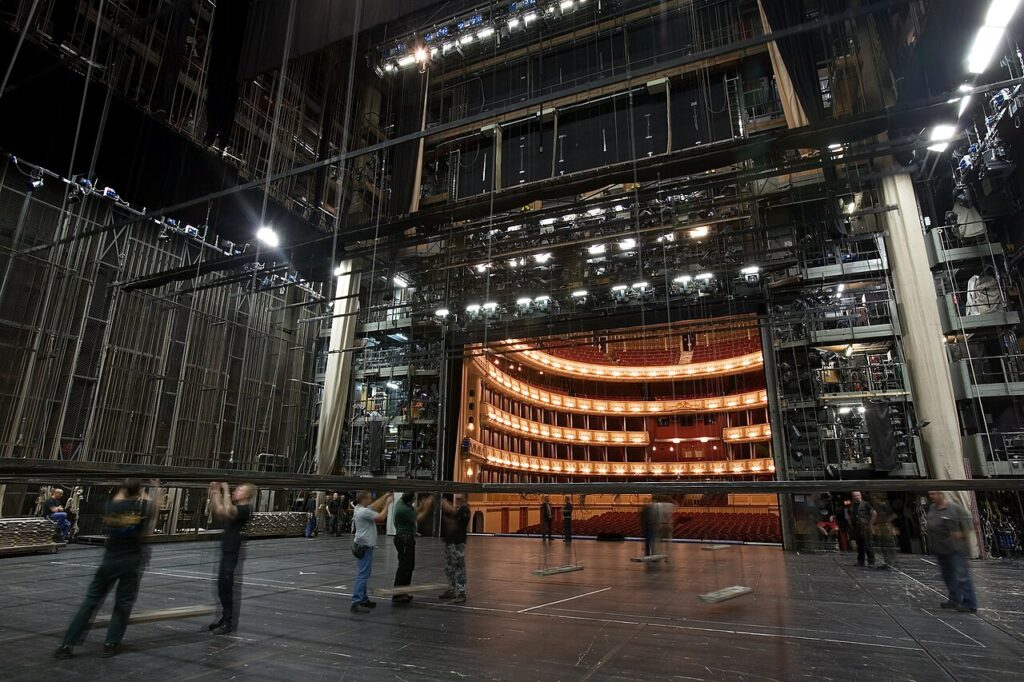
Featured image: Photograph: Jorge Royan, CC BY-SA 3.0; WordPress may resize the display. Backstage preparation at the Vienna State Opera; an example of theatrical lighting and rigging, not Fences.