Broadway History
From the 1987 Premiere to the 2010 Broadway Revival of Fences
An evidence-based timeline connecting the first Broadway production of August Wilson’s Fences to the celebrated 2010 revival.
A Broadway revival is more than a second chance to sell tickets to a familiar title. It asks a new group of artists to encounter a work whose reputation has already been formed, and it asks audiences to discover what the work means in their own moment. That was the situation facing the first Broadway revival of August Wilson’s Fences in 2010. The play had already achieved major recognition, but the revival offered fresh performances, a new creative team and a different cultural vantage point.
The revival opened at the Cort Theatre on April 26, 2010, with Denzel Washington as Troy Maxson, Viola Davis as Rose and Kenny Leon directing. It closed July 11. Those dates, along with the full production credits and awards, appear in the Internet Broadway Database. To understand why the engagement mattered, it helps to distinguish the documented chronology from the broad interpretations that followed it.
The 1987 Broadway production established the play
The original Broadway production of Fences opened on March 26, 1987, at the 46th Street Theatre, now known as the Richard Rodgers Theatre. Contemporary coverage of the 2010 revival described the original as both Pulitzer Prize-winning and Tony Award-winning. A 2010 BroadwayWorld ticket announcement documents the opening date and original venue.
The original production placed Wilson’s story of the Maxson family before Broadway audiences at a time when the playwright was becoming a defining voice of American theater. The role of Troy was originated on Broadway by James Earl Jones, who is prominently associated with the original production. This context matters because actors revisiting the play do not begin with an empty theatrical canvas. Their interpretations enter a conversation with a production history that audiences, reviewers and fellow artists may already know.
That history need not be a burden. A major play can support readings that emphasize different aspects of its characters. The writing remains stable, but the social conversation around work, race, parenthood and generational responsibility continues. A revival is an opportunity to test which parts of the text remain immediate and which demand renewed attention.
Why the 2010 engagement attracted notice
The decision to cast Washington and Davis placed two highly regarded performers at the center of the revival. Advance coverage also identified Kenny Leon as director and described the run as a limited engagement. The performances were scheduled at the Cort Theatre, a Broadway venue whose intimate dramatic setting was appropriate for a work rooted in family conversations.
The important point is not celebrity alone. A cast can attract attention, but the work must sustain that attention once the curtain rises. Fences asks audiences to remain with characters whose choices can be recognizable and troubling at the same time. It does not offer uncomplicated heroes or villains, and its power depends on actors giving those contradictions room to develop.
Playbill’s March 30, 2010 report described the principal cast and announced the musical and design contributors. The document provides contemporary evidence for the production plan rather than a retrospective account shaped by later successes.
A chronological outline of the revival
January–March 2010: Ticket announcements and casting reports established the production’s principal performers and limited engagement. March coverage identified Branford Marsalis as the composer of original music and listed the design team.
April 14, 2010: Previews began at the Cort Theatre. Previews are part of a Broadway production’s public development, preceding the formal opening and associated critical response.
April 26, 2010: The revival officially opened. The Internet Broadway Database records the date and theater, along with the full list of performers.
June 2010: The production received three Tony Awards: Best Revival of a Play, Best Actor in a Play for Washington and Best Actress in a Play for Davis. The award record also lists nominations recognizing other members of the production and creative team.
July 11, 2010: The limited engagement concluded. IBDB records 13 previews and 88 regular performances.
A chronology helps prevent a common problem in writing about older theater: mixing announcements, performances, reviews and later memories into one undated narrative. Each stage of the record answers a different question. An advance announcement tells us what was planned; a database documents what was presented; an interview or review may illuminate how it was experienced.
A creative team beyond the marquee
The 2010 revival included original music by Branford Marsalis, scenic design by Santo Loquasto, costume design by Constanza Romero, lighting design by Brian MacDevitt and sound design by ACME Sound Partners. These credits appear in both IBDB and contemporary Playbill coverage.
This range of collaboration is important in a drama that may seem to consist primarily of people talking in a backyard. A theatrical environment shapes attention before an actor speaks. The visual and sonic world also helps an audience understand when the action is situated and where its emotional center lies. Credits identify the responsible artists, but particular effects should not be invented when stage documentation is unavailable.
Our creative-team page gathers these contributors in one place, while the cast page explains the roles represented in the 2010 ensemble.
Recognition and the limits of awards as history
The revival’s three Tony wins are important facts. Best Revival of a Play acknowledges the production as a whole, while the performance awards recognize Washington and Davis. Awards help document reception, but they are not the only measure of a production’s influence, and they cannot convey what every member of the audience experienced.
Other forms of evidence matter as well: press coverage, production programs, interviews, reviews and reliable theater databases. Each can contribute a different kind of knowledge. An archival approach becomes stronger when these sources are named and their scope is respected. The IBDB record is especially useful for dates and formal credits. Contemporary journalism is useful for announcements and the public conversation as it happened.
This distinction protects the history from a tempting but misleading shortcut: describing later cultural importance as though everyone in 2010 knew what would follow. Theater is made in the present tense. A production can later become a reference point, but the original spectators encountered living performers and an unfolding performance, not a completed legacy.
The play continued beyond one Broadway engagement
Fences remains a significant work because its concerns are neither restricted to a specific set of performers nor exhausted by a single interpretation. The 2010 revival is a meaningful chapter, but it does not replace the 1987 production or the drama itself. Readers and audiences can approach the text through its family relationships, its portrayal of racial barriers, its treatment of work and aspiration, or the way personal stories become inherited expectations.
That is why a website about the 2010 production can still serve a useful purpose after the run has closed. It can give visitors correct dates, credited names, a clear explanation of the play and links to trustworthy references. It should not pretend tickets remain on sale or present later commentary as though it were the original site’s copy.
Another lasting contribution of a carefully documented production page is its usefulness to people who never saw the event. Students can distinguish the play from one particular staging. Reviewers can compare the revival with earlier interpretations without assigning unsupported motives to individual artists. Theatergoers can recognize the difference between the period in which the story takes place and the year when the performance occurred. That clarity allows a small production website to function as a reliable reference rather than a collection of promotional claims. It also encourages readers to return to the primary theatrical record when details are uncertain.
For an interpretive companion, read the fence as a dramatic image. For the original production facts, visit the 2010 show overview or the Fences on Broadway homepage.
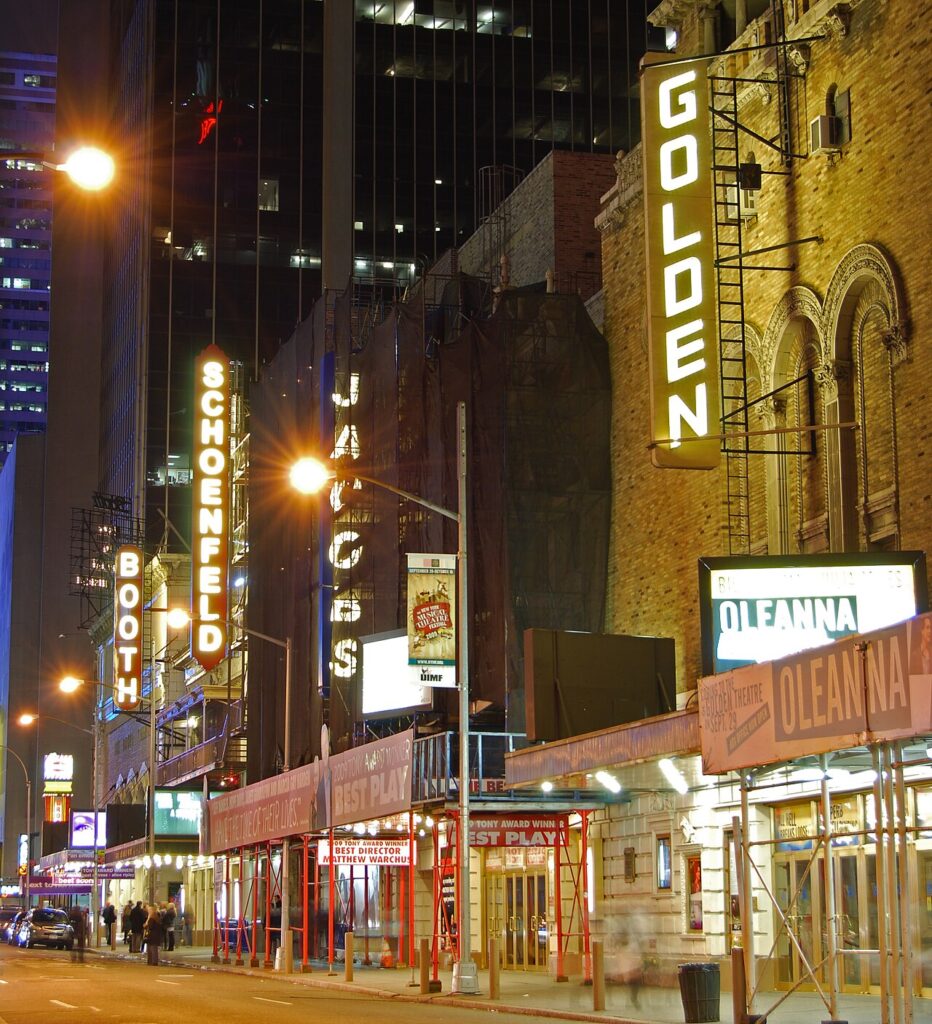
Featured image: Photograph: Matt H. Wade (UpstateNYer), CC BY-SA 3.0; WordPress may resize the display. Broadway theatres on West 45th Street in 2009; historical neighborhood context, not the Fences venue.